Activity #1: Understanding Creative Practices
- Gabrielle Vebryzky

- Jul 13, 2021
- 10 min read
Updated: Jul 14, 2021
Examine creative practises in art and design by researching them in historical and contemporary contexts.
Achille Castiglioni

Achille Castiglioni was an Italian industrial designer who was famous for his unique, yet fun designs. Graduating with a professional degree in architecture, Achille Castiglioni started his own design office along with his brothers.
Historical Context
Graduating with a professional degree in architecture, Achille Castiglioni was able to use the knowledge he had acquired and create a variety of distinctive and unique designs that is fully functional while keeping its aesthetically pleasing designs.
Contemporary Context
Being established in the year 1956, Achille Castiglioni became one of the founding members of the Association for Industrial Design—or ADI. With his knowledge and experiences, he then became a professor of design as a way to contribute and form the foundation of the future of the field of design.
What motivated the practice?
Achille Castiglioni joined the design industry with the idea of exploring and experimenting with new and different shapes, techniques, and materials. This results in his designs being fun and distinctive.
What influenced the practice?
His curiosity, creativity, and experimental side are what mainly influenced the creation of his designs. Another important factor is having a professional degree in architecture, which made Achille's design fully functional while still having a pleasing design.
What are the differences between then and now?
Back then, the technology used was not as advanced as today's technology. The main difference in the product designed by Achille Castiglioni is the improvement of the technology quality for the final product.
What stays the same?
Even though the quality of the product may have changed, the design would stay the same.
Works
Taccia Lamp:

Arco Lamp:

Snoopy Lamp:

David Airey

David Airey is a graphic designer, writer, and brand consultant who have created a variety of logos and visual identities for different brands. By having different experiences in between his studies, David Airey quickly became a self-employed graphic designer by the year 2005.
Historical Context
Being passionate about art at 15, David Airey quickly became interested in graphic design and graduated with an honours degree in graphic communications management as well as a post-graduate diploma in management.
Contemporary Context
With his knowledge and skill in the industry, David Airey focuses on logo and brand identity design. He also created design books as a guide for those who wish to learn more about logo and visual branding.
What motivated the practice?
David Airey used to take an art design course in college as he finds it interesting. This results in him working as a graphic designer and specializing in logo and visual branding as he saw a large number of opportunities and variety in the logo and visual branding niche.
What influenced the practice?
As he met more clients, it allows him to learn more regarding design. This is caused by the difference in the needs of each brand, making him more exposed to new concepts and ideas.
What are the differences between then and now?
—
What stays the same?
The process of creating the designs remain the same as he always starts with research, followed by the creative strategy, design, and implementation.
Works:
Unforgiven Souls:

Ecometrica:

Montville Coffee:

Es Devlin

Es Devlin, an artist and stage designer, is known for her out-of-the-box 3D model creations or set designs. Her creations have made people acknowledge her as one of the most influential and remarkable set designers.
Historical Context
The start of her journey as a stage designer happened when she began taking a course in theatre design for a year in which she created a variety of 3D models. In the end, she won a prize for stage design. Her first major stage design was done at the play called Betrayal by Harold Pinter, where she uses gadgets to create the backgrounds for the play (it was unusual to use projectors/gadgets for plays at that time).
Contemporary Context
With her skills in creating models and generating ideas, Es Devlin was able to effectively mix the use of 3D model objects and gadgets in her designs. Her works have opened a new pathway in design as she uses illusions and a new perspective in most designs, which most designers have never seen and thought of.
What motivated the practice?
Es Devlin first realized her love for creating 3D models was when she took a course in theatre design.
What influenced the practice?
Her work is influenced by her creativity and imagination, which is just some of her strongest aspect. She is also capable of seeing, thinking, and creating things that require a new perspective.
What are the differences between then and now?
The difference between then and now in her creations is the use of technology. With the constant advancement in technology, she is able to create more props/sculptures with technology being a part of them.
What stays the same?
The process of creating her works stays the same. Having to sketch several ideas and consult with the client being one of them. Another aspect that stays the same is the way she uses physical objects to brainstorm (create miniatures) as the base of her work instead of doing it digitally.
Works
Memory Palace - Pitzhanger Manor & Gallery:
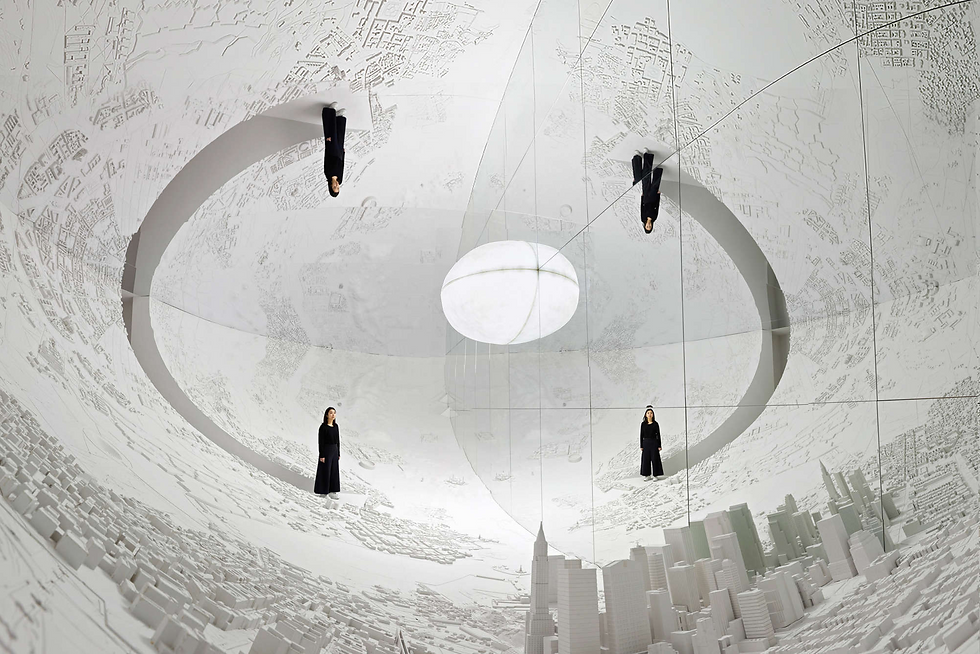
Louis Vuitton – Series 2 Exhibition:

Kanye West & Jay-Z – Watch the Throne Arena Tour:

Jessica Walsh

Jessica Walsh is considered to be the ideal graphic designer that have ever existed today. Based in New York, Jessica Walsh is an art director, designer, and founder of & Walsh. She was once the partner of a design studio—known as Sagmeister & Walsh—before she created her own design studio.
Historical Context
During her elementary days, Jessica Walsh was interested with graphic design, where it leads her to Rhode Island School of Design. Alongside of taking graphic design classes, she also took fine arts classes—which exposed her to painting, woodwork, drawing, and sculpture. Another significant part from her learning days happened during high school. During those days, Jessica Walsh learned about coding. With her skills and knowledge, she was able to create websites for individuals, as well as small businesses.
Contemporary Context
Having the skills, knowledge, and experiences, Jessica Walsh was offered to work at Stefan Sagmeister's studio in which it was renamed as Sagmeister & Walsh years later. However, by the year 2019, Jessica left and begin running her own studio & Walsh.
What motivated the practice?
Jessica Walsh have always enjoyed creating art, whether its making packaging or creating logo. By understanding that her hobby could be used as the main source of her income, she became motivated to become a designer to make money.
What influenced the practice?
The artworks she creates is mostly influenced by the knowledge and skill she have gained during her learning days, where she became exposed to different forms of art. With the skills and knowledges she have gained, she used art as a media to express herself. As a result, her works became the reflection of who she really is.
What are the differences between then and now?
—
What stays the same?
Jessica Walsh tends to use contrasting, bold, and solid colors in her works. These contrasting colors highlights the areas where she puts as the main focus. This allows people to focus more on the main areas of her work. Jessica uses art as her main medium of self expression.
Works
Milly: Color Lover:

Kenzo Campaign:

Plenty:

Malika Favre

Malika Favre is a French illustrator and artist who is known for her art style, which is a mix of Pop and Op art. Her artworks are made using strong and simple shapes, negative spaces, along with bold colors.
Historical Context
Ever since she was 3 years old, Malika Favre have always enjoyed drawing. One of the things that she could draw was the human body.
Malika Favre was born with a severe case of strabismus, which affects the way she sees things. This results in her seeing light and shadow as 2D things.
Contemporary Context
Malika Favre created her artwork based on her own perspective. Thus, her artwork is considered to be an optical art, due to the use of colors that made the images appear to pop. Another method she applied to her art is the use of different colors to represent shadows, creating perspective in her artwork.
What motivated the practice?
Malika Favre has always been interested in art since she was 3 years old.
What influenced the practice?
Her work is mostly influenced by her personal perspective on things, as well as her understanding of light and shadow.
What are the differences between then and now?
—
What stays the same?
Her art style remains the same until today.
Works
Saint Augustine - The New Yorker:

The Butterfly Effect - The New Yorker:

Symphonie au Balcon - Vogue Spain:

Analyse your own area of specialism in relation to historic and contemporary practices.
Personal Field of Specialism: Graphic Design
Interests: Graphic Design, Set Design, Interior Design, Industrial Design
Specialism: Graphic Design
I consider graphic design as my specialty due to my past experiences in creating visual communication media for my past school projects. Another reason is due to my past and current learning experience regarding different software (Photoshop, Illustrator, InDesign, XD).
Graphic design: the creation of visual content to convey messages.
Graphic design requires the application of different design techniques. This includes:
Typography
Colors
Images
With these techniques, designers would be able to create and convey the main message while optimizing the user's experience.
Importance of Graphic Design:
Due to its focus on communication, graphic design is mainly used to create a proper brand image for businesses, whether it is through their logo, brochures, websites, or other media. Different businesses have different core values and morals. With the proper designs, these businesses are able to convey their exclusive identity easily with the help of graphic design.
Another purpose of graphic design is to create aesthetically pleasing designs. People tend to be attracted to visually appealing designs. As a result, most consumers would direct their attention to that specific object or brand.
Historical Context:
Before graphic design became the official form of what it is today, the roots of this form of visual communication could be traced back to 38,000 BC. Cave paintings were considered to be a form of visual communication whether it is to their gods or to one another.

During the time of 3,300 - 3,000 BC, the main form of communication is the Sumerian language, one of the first forms of written language. The first forms of written language were considered to be logographic—characters that represent a word instead of sounds.

In 200 BC, China created the first form of printing by using wood relief. The wood relief was used to print and stamp the silk clothes, which was then changed to paper. By the year 1040, the first movable printing press was made by a man named Bi Sheng.

Typography became an important part of the formation of letters and words.

The European Heraldry was the first form of logo creation. Back then, it was used to represent different family houses and territories.

However, the use of the logo began to change. In the end, logos are used to represent companies.

Contemporary Context
The first graphic design agency was known as the Wiener Werkstätte. This agency was formed in the year 1903 in Austria. Being the first organization to include all types of visual artists (painters, architects, and graphic designers), the Wiener Werkstätte changed the business and creative industry.

By the year 1919, a German creative agency known as Staatliches Bauhaus was formed. The formation of Bauhaus greatly impacted the design world, introducing a new modernized art style.

Analysis
Today, graphic designs involve the use of logos, typography, colors, and icons. All these elements became an important part of visual communication as these elements would each represent different things. One of the main differences between then and now is the relationship between the elements. In creating the designs, each element plays a significant part, and some may even be combined (e.g. typography is used to make a logo or be the logo itself).
The correlation between my specialism with the historic and contemporary context regarding graphic design is the use of elements. Each element I used in my past works is either used as aesthetics or has a deeper meaning in which I would like to convey.
Another analysis that was prominent to me is how each form of creative practice (e.g. industrial design, architecture, illustration, graphic design, etc.) all played a part in the growth of new styles and designs in the creative industry (e.g. The modernism style created by Bauhaus has different characteristics that could be implemented into interior design, architecture, illustrations, etc.)
Evaluation
Researching about the history of graphic design has shown that everything that was done in the past has greatly impact today's form of visual communication. As stated in the analysis, today's graphic design uses elements that came from the past (colors, typography, logo, and icons). Another aspect that stays in the present day is the use of logos to represent the company (today's use of logo has expanded: e.g. brand image). Personally, I believe today's graphic design has become better. This form of visual communication is able to convey more messages than before. In fact, it may even change our personal perspective on many things.
Bibliography:
Anon, 2017. Malika Favre. Communication Arts. Available at:
https://www.commarts.com/features/malika-favre [Accessed July 12, 2021].
Anon, 2019. A Tribute to the Genius of Achille Castiglioni. FLOS USA, Inc. Available at:
https://usa.flos.com/blog/tribute-to-achille-castiglioni [Accessed July 12, 2021].
Anon, 2019. Student interview answers. David Airey. Available at: https://www.davidairey.com/interview
[Accessed July 12, 2021].
Anon, 2020. Process: David Airey: brand identity design. David Airey. Available at:
https://www.davidairey.com/process [Accessed July 12, 2021].
Anon, Es Devlin On Her Creative Process and Embracing Mistakes - Google Arts & Culture. Google.
Available at: https://artsandculture.google.com/theme/es-devlin-on-her-creative-process-and-
embracing-mistakes/aAKy4tUEpwQkLg?hl=en [Accessed July 12, 2021].
Anon, Famous Graphic Designer Profile: Jessica Walsh and brand design. Welcome to Digital Art
Teacher! Available at: https://www.digitalartteacher.com/blog/2019/11/famous-graphic-designer-
profile-jessica-walsh-and-brand-design [Accessed July 12, 2021].
Anon, Malika Favre. IMDb. Available at: https://www.imdb.com/name/nm6454114/bio [Accessed July 12,
2021].
Anon, What is Graphic Design? The Interaction Design Foundation. Available at: https://www.interaction-
design.org/literature/topics/graphic-design [Accessed July 12, 2021].
Creative Waffle, 2019. The making of a graphic design book - David Airey: Ep 134. [YouTube Video].
Available at: https://youtu.be/K8DOZ4CtGx4 [Accessed July 12, 2021].
Ellis, M., 2018. A brief history of graphic design. 99designs. Available at:
https://99designs.com/blog/design-history-movements/history-graphic-design/ [Accessed July 12,
2021].
Favre, M., 2019. My breakthrough moment: Malika Favre. Creative Review. Available at:
https://www.creativereview.co.uk/my-breakthrough-moment-malika-favre/ [Accessed July 12,
2021].
FLOS USA Lighting, 2019. Flos Taccia : Table lamp by Castiglioni. [YouTube Video]. Available at:
https://youtu.be/D4on3XiTjjY [Accessed July 12, 2021].
Iype, J., 2020. Remembering Achille Castiglioni, the master of industrial design. STIRworld. Available at:
https://www.stirworld.com/inspire-people-remembering-achille-castiglioni-the-master-of-
industrial-design [Accessed July 12, 2021].
Jessica Walsh. Kenzo Campaign. [Picture].
Jessica Walsh. Milly: Color Lover. [Picture].
Jessica Walsh. Plenty. [Picture].
Lewis, T., Designer Es Devlin: all the world's her stage. The Guardian. Available at:
https://www.theguardian.com/lifeandstyle/ng-interactive/2019/sep/29/designer-es-devlin-all-the-
worlds-her-stage [Accessed July 12, 2021].
Malika Favre. Saint Augustine. [Picture].
Malika Favre. Symphonie au Balcon. [Picture].
Malika Favre. The Butterfly Effect. [Picture].
McGuinness, M. et al., 2017. An Interview with David Airey, Graphic Designer - Mark McGuinness:
Creative Coach. Mark McGuinness | Creative Coach. Available at:
https://lateralaction.com/articles/david-airey-graphic-designer/ [Accessed July 12, 2021].
Moorhouse, G., About. Malika Favre. Available at: https://www.malikafavre.com/about [Accessed July 12,
2021].
Netflix, 2020. Abstract: The Art of Design: Es Devlin: Stage Design: FULL EPISODE: Netflix. [YouTube
Video]. Available at: https://youtu.be/jo4aAVjuh2o [Accessed July 12, 2021].
Peoplepill.com, About Jessica Walsh: American graphic designer: Biography, Facts, Career, Wiki, Life.
peoplepill.com. Available at: https://peoplepill.com/people/jessica-walsh [Accessed July 12, 2021].
Velocity Consultancy, 2021. 6 Benefits Of Graphic Design For Businesses In 2020. Velocity
Consultancy. Available at: https://www.velocityconsultancy.com/benefit-of-graphic-design-for-
business/ [Accessed July 12, 2021].


Comments